

When most people think of Attention Deficit Hyperactivity Disorder (ADHD), they picture a young boy bouncing off the walls of an elementary school classroom. Because of this outdated stereotype, millions of adults — especially moms — navigate their careers, relationships, and homes completely unaware that their daily internal struggles are actually textbook symptoms of adult ADHD.
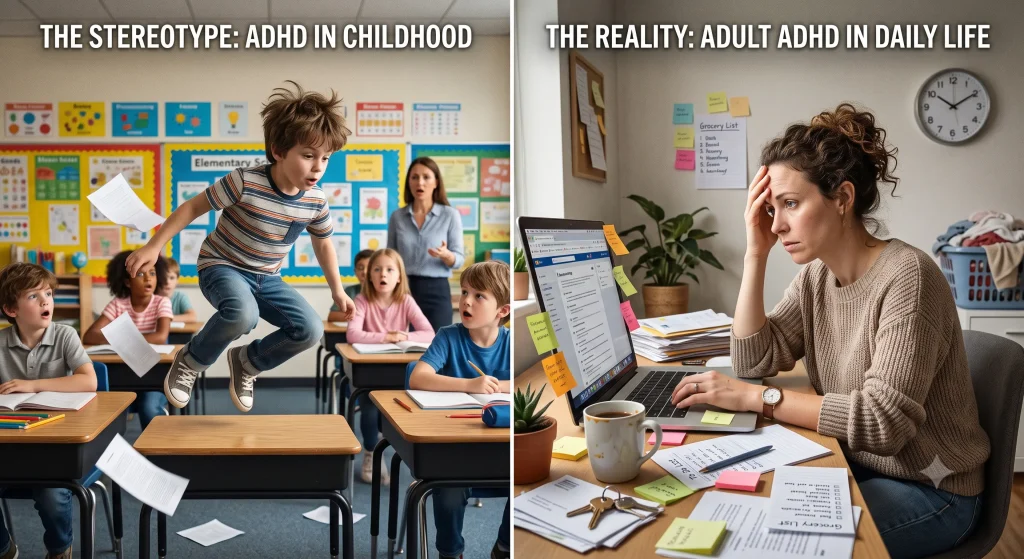
ADHD doesn’t disappear when you turn eighteen. Instead, the hyperactivity and executive dysfunction mutate into quieter, more insidious internal challenges that make the demands of adult life — and especially motherhood — feel uniquely overwhelming.
If you’ve spent years labeling yourself as “scattered,” “lazy,” or “too dramatic,” it might be time to look closer at how your brain actually operates. Here’s an honest look at how adult ADHD shows up in everyday life.
1. Chronic Disorganization and Forgetfulness
In adulthood, executive dysfunction transforms physical spaces into reflections of internal mental clutter. This often shows up as a cluttered workspace, overflowing inboxes, or a chaotic digital desktop. Alongside physical disorganization comes persistent forgetfulness — misplacing keys, forgetting why you walked into a room, or letting important dates slip through the cracks despite your best efforts.
2. The Trap of Impulsive Decisions
The ADHD brain struggles with dopamine regulation, meaning it constantly craves immediate reward and stimulation. This makes it difficult to pause and weigh long-term consequences. In daily life, this can look like impulsive online spending, abruptly quitting a job out of frustration, or making rash decisions that leave you cleaning up the emotional or financial aftermath later.
3. Trouble Focusing and Completing Tasks
While adult ADHD can occasionally cause bursts of deep hyperfocus, its primary hallmark is difficulty regulating attention on demand. You might be easily distracted by background noise, a stray thought, or a phone notification. This makes task completion a major hurdle — it’s common to start several projects with high energy, only to abandon them halfway through once the novelty wears off.
⏰ Chronic Lateness
Constantly missing deadlines and arriving late due to severe “time blindness” — the brain’s inability to accurately judge how much time has passed.
😣 Restlessness
An inability to physically or mentally unwind, keeping the nervous system stuck “on edge” even during downtime.
4. Chronic Lateness and Missed Deadlines
Many adults with ADHD experience “time blindness” — difficulty gauging how long a task will actually take. This can cause you to run late to work, appointments, or social events, and it makes long-term planning difficult, leading to a constant cycle of playing catch-up.
5. Persistent Internal Restlessness
While children with ADHD express hyperactivity physically, adults tend to internalize it. This shows up as a deep, uncomfortable restlessness — an inability to relax even during free time, as if your brain is running on an internal motor you can’t shut off.
6. Emotional Dysregulation
Perhaps the most overlooked part of adult ADHD is how it affects your emotional baseline. The ADHD brain lacks the filtering system that helps neurotypical people moderate reactions. This can cause intense mood swings — moving from calm to deeply frustrated in seconds — where minor setbacks trigger disproportionate waves of frustration.
Why This Hits Different for Moms
Every symptom above gets amplified the moment you add sleep deprivation, hormonal shifts, and the invisible mental load of motherhood into the mix. Many women don’t recognize their ADHD until after having children, when the demands of managing a household, a career, and tiny humans finally overwhelm coping strategies that used to work.
If any of this sounds familiar, you’re not alone — and you’re not failing. Explore more on:
- ADHD Motherhood Challenges No One Talks About
- Building an ADHD-Friendly Mom Daily Routine
- ADHD Mom Schedule Tips to Stay Organized
- ADHD Emotional Regulation Strategies
Not Sure If It’s ADHD, Anxiety, or Mom Burnout?
Download my free ADHD Motherhood Guide to start untangling what’s really going on — and get practical, judgment-free tools built specifically for moms.
Changing the Narrative: Understanding vs. Blame
If these symptoms resonate with your daily experience, the most important step you can take is to change how you talk to yourself. Living with undiagnosed or unmanaged ADHD often builds a heavy layer of shame, leading adults to believe they’re fundamentally broken or incompetent.
Recognizing these traits isn’t about excusing poor habits — it’s about finding an accurate map of how your brain works. Once you understand your brain is simply wired differently, you can stop using shame as a motivational tool and start building neurodivergent-friendly structures that let your unique brain thrive. You aren’t broken — you’re just learning how to steer a highly complex mind.
Frequently Asked Questions
What does undiagnosed adult ADHD feel like?
It often feels like constantly falling behind — chronic lateness, forgetfulness, restlessness, and emotional overwhelm — despite trying harder than everyone around you.
Can ADHD symptoms get worse after having a baby?
Yes. Sleep deprivation, hormonal changes, and the added mental load of caring for a child frequently intensify ADHD symptoms, which is why many women are first diagnosed postpartum. Learn more about postpartum coaching support.
Is ADHD coaching different from therapy?
Yes. Coaching focuses on building practical systems and daily strategies, while therapy addresses deeper emotional processing. Read our full breakdown: Therapy vs. Coaching for Moms.
Do you offer virtual ADHD coaching outside Minnesota?
Yes! Melissa offers virtual coaching nationwide, in addition to in-person sessions in Apple Valley, Minneapolis, and St. Paul.
You Don’t Have to Figure This Out Alone
If you recognized yourself in this article, it may be time for a conversation. Melissa Nokes, MA, PMH-C, helps moms across Minnesota and virtually nationwide manage ADHD, anxiety, and the overwhelm of motherhood with judgment-free, practical coaching.