Last Updated: 19th Aug 2026 | Reviewed by a Licensed Mental Health Professional | Reading Time: approximately 18 minutes
Medical Disclaimer: This article is for informational purposes only and does not constitute medical advice. If you are experiencing a mental health emergency or severe symptoms, please contact a qualified healthcare professional or call emergency services immediately.
How to Reduce Anxiety Immediately (Quick Answer)
When anxiety strikes, your body has already shifted into emergency mode. Your heart races, your breathing shallows, and your brain starts scanning for threats — real or imagined. The good news? You can interrupt that cycle fast.
To reduce anxiety immediately, you need to do one thing above all else: send a safety signal to your nervous system. Your brain triggered the alarm; your job is to convince it the danger has passed. The fastest and most evidence-backed ways to do that include controlled breathing, sensory grounding, cold water exposure, physical movement, and muscle relaxation — all of which you can do right now, wherever you are.
Top 5 Fastest Methods to Reduce Anxiety Right Now:
- ✅ Slow diaphragmatic breathing — inhale for 4 seconds, exhale for 6 to 8 seconds
- ✅ 5-4-3-2-1 grounding technique — anchor yourself to the present using your five senses
- ✅ Cold water shock — splash ice-cold water on your face or hold an ice cube
- ✅ Progressive muscle relaxation — tense and release each muscle group from top to bottom
- ✅ Brief physical movement — jumping jacks, a fast walk, or vigorous hand shaking
Important: For ongoing, frequent, or severe anxiety, professional support is strongly recommended. The techniques in this guide are safe and evidence-informed for mild to moderate anxiety, but they are not a substitute for clinical care. Jump to Step-by-Step Guide
What Is Anxiety and Why Does It Hit So Hard?
Before you can effectively fight anxiety, it helps to understand what you are actually fighting. Anxiety is not a character flaw, a sign of weakness, or something you should simply be able to “push through.” It is a deeply wired biological survival response — and knowing that changes everything about how you respond to it.
The Science Behind Anxiety Attacks
When your brain perceives a threat — whether that threat is a charging lion or an unanswered email from your boss — a small, almond-shaped structure called the amygdala fires an alarm. Within milliseconds, your adrenal glands flood your bloodstream with stress hormones, primarily adrenaline (epinephrine) and cortisol.
These hormones trigger a cascade of physical responses designed to help you survive:
- Heart rate accelerates to pump more blood to your muscles
- Breathing becomes faster and shallower to take in more oxygen
- Digestion slows down (energy is redirected away from non-essential functions)
- Muscles tense and prime for action
- Sweating increases to cool the body in anticipation of physical exertion
This is the famous fight-or-flight response, and it is incredibly effective when the threat is physical and immediate. The problem is that the human brain in the modern world often cannot tell the difference between a genuine physical threat and a stressful thought, a social situation, or an anticipated future event.
Your body launches the same survival response whether you are running from a predator or sitting in a traffic jam worrying about being late. The adrenaline floods in either way. And when there is no physical danger to run from or fight, that excess adrenaline has nowhere to go — which is precisely why anxiety feels so overwhelming, so physical, and so out of control.
The important thing to understand is this: anxiety feels dangerous, but it is not. Your body cannot sustain peak fight-or-flight activation indefinitely. The physiological response will always peak and then diminish. Knowing this is itself one of the most powerful tools you have.
Difference Between Anxiety and a Panic Attack
These two terms are often used interchangeably, but they are meaningfully different — and knowing the distinction helps you respond more effectively.
Anxiety tends to build gradually. It is often tied to a specific worry, situation, or anticipation of something negative. It can linger for hours, days, or even longer, and its intensity tends to fluctuate rather than spike suddenly.
A panic attack is a sudden, intense surge of fear or discomfort that peaks rapidly — typically within 10 minutes — and then subsides. It often occurs unexpectedly, sometimes with no obvious trigger, which makes it especially frightening. During a panic attack, people frequently fear they are dying, having a heart attack, or losing control of their mind.
| Feature | Anxiety | Panic Attack |
|---|---|---|
| Onset | Gradual | Sudden |
| Duration | Can linger for hours or days | Peak lasts 5–10 minutes; total 20–60 minutes |
| Trigger | Usually identifiable | Often feels random |
| Intensity | Moderate to high | Extremely intense |
| Physical symptoms | Present but manageable | Overwhelming |
| Fear of dying | Less common | Very common |
Understanding which experience you are having matters because it shapes which technique you reach for first. Panic attacks respond exceptionally well to cold water shock and breathing. General anxiety often responds better to grounding, movement, and cognitive reframing.
Common Triggers of Acute Anxiety Episodes
Anxiety triggers vary enormously from person to person. However, they generally fall into four broad categories:
Situational triggers include things like workplace pressure, job loss, relationship conflict, divorce, financial stress, health concerns, or major life transitions such as moving, having a baby, or retirement. Even positive events can trigger anxiety when they involve significant change or uncertainty.
Sensory triggers are more subtle but equally powerful. A particular smell, sound, or visual image can unconsciously activate the threat-detection system — especially if it is connected to a past stressful or traumatic experience. This is a core mechanism in PTSD, but it also operates in everyday anxiety.
Internal triggers are perhaps the most common and the most underrecognized. Catastrophic thinking patterns such as “What if everything goes wrong?”, negative self-talk, ruminating about past mistakes, or anticipating worst-case future scenarios are all internal triggers that keep the anxiety cycle running.
Physical triggers include stimulants like caffeine and nicotine, poor or disrupted sleep, certain medications, illness, dehydration, low blood sugar, and hormonal fluctuations. These physical states lower your body’s baseline threshold for anxiety, meaning it takes less to tip you into a stress response.
Signs You Need to Reduce Anxiety Immediately Right Now
Recognizing anxiety in yourself — especially in the moment — is not always easy. Many people experience physical symptoms for years before connecting them to anxiety. Others dismiss mental and emotional symptoms as “just stress.” Here is a comprehensive look at what anxiety actually looks and feels like across three dimensions.
Physical Symptoms of Anxiety to Watch For
- Racing or irregular heartbeat — often described as pounding, fluttering, or skipping
- Dizziness and light-headedness — a common result of altered breathing patterns
- Chest tightness or pain — frequently mistaken for cardiac symptoms
- Sweating — especially on palms, underarms, or the back of the neck
- Shaking or trembling — visible or internal, from head to extremities
- Shortness of breath — feeling unable to take a full, satisfying breath
- Nausea, stomach cramps, or bloating — the gut-brain connection is direct and powerful
- Tingling or numbness — especially in fingers, lips, or face, related to changes in blood flow
- Feeling hot or cold suddenly — as the body tries to regulate its temperature
Mental and Emotional Symptoms
- Intense, overwhelming fear — often disproportionate to the actual situation
- Racing or intrusive thoughts — the mind running at full speed, often in loops
- Derealization or depersonalization — feeling detached from yourself or your surroundings, as if watching yourself from outside
- Inability to concentrate — the anxious brain prioritizes threat-scanning over everything else
- Fear of losing control or dying — especially during panic attacks, this can feel absolutely convincing
Behavioral Warning Signs
- Avoidance — steering clear of situations, places, or people that have triggered anxiety before
- Compulsive checking — repeatedly checking locks, messages, health symptoms, or safety
- Inability to relax or enjoy leisure activities — anxiety follows you into rest
- Social withdrawal — pulling away from friends and family to feel “safer”
- Difficulty maintaining routines — anxiety disrupts sleep, eating, exercise, and work patterns
⚠️ Safety Note: Chest pain and shortness of breath can sometimes signal a medical emergency, including a heart attack or pulmonary embolism. If your symptoms are severe, sudden, or you are unsure whether you are experiencing anxiety or a medical crisis — seek immediate medical attention. Do not rely solely on self-help techniques when in doubt. This guide does not replace professional medical advice.
How to Reduce Anxiety Immediately — Step-by-Step Methods That Work
This is the most important section of this guide. Each technique below is grounded in physiology or psychology research, is accessible without any equipment or training, and has been used successfully by millions of people worldwide. Read through all ten first, then identify the two or three that resonate most with you. Practice them before you need them, so they become automatic when anxiety hits.
Step 1 — Start With Controlled Breathing (Fastest Method)
What it is: Controlled breathing directly activates the parasympathetic nervous system — the part of your nervous system responsible for the “rest and digest” state that is the opposite of fight-or-flight.
Why it works: When you breathe slowly and extend your exhale, you engage the vagus nerve — the longest cranial nerve in your body and the primary communication highway between your brain and your vital organs. A long, slow exhale sends a direct signal to the brain that says: the emergency is over. Your heart rate slows. Your muscles soften. Your mind begins to clear.
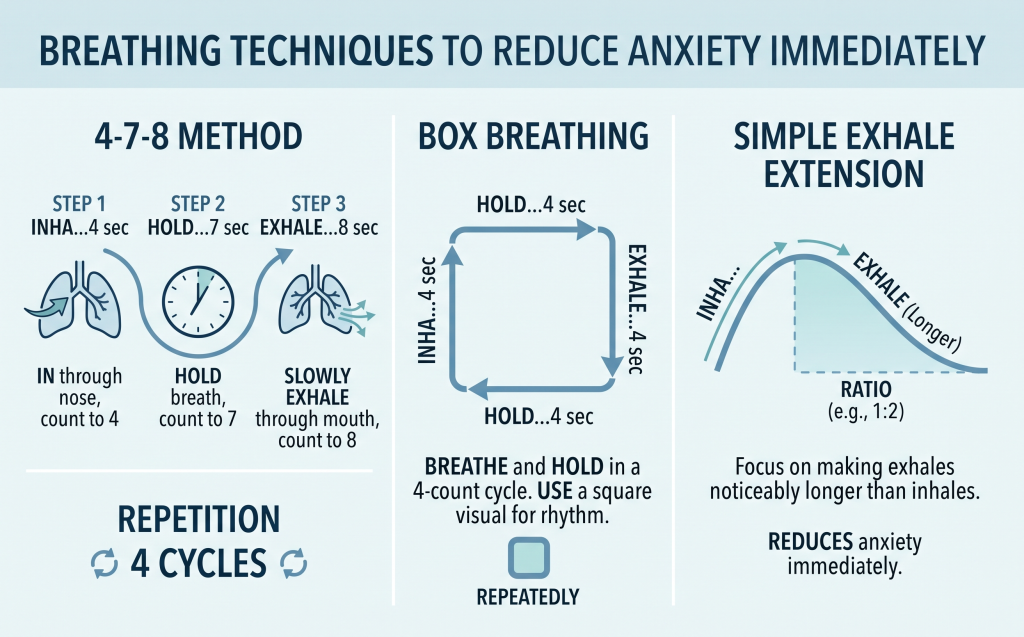
How to do it — three proven methods:
Method 1: Simple Exhale Extension (Best for Beginners)
- Inhale slowly through your nose for 4 seconds
- Exhale slowly through your mouth for 6 to 8 seconds
- Repeat 6 to 10 times
- Speed of relief: 1 to 2 minutes
Method 2: 4-7-8 Breathing (Best for Deep Calm)
- Inhale quietly through your nose for 4 seconds
- Hold your breath for 7 seconds
- Exhale completely through your mouth for 8 seconds
- Repeat 4 cycles
- Speed of relief: 3 to 5 minutes
Method 3: Box Breathing (Best for Focus and Performance Anxiety)
- Inhale for 4 seconds
- Hold for 4 seconds
- Exhale for 4 seconds
- Hold for 4 seconds
- Repeat 4 to 6 rounds
- Speed of relief: 3 to 5 minutes
Pro tip: Place one hand on your chest and one hand on your belly. During diaphragmatic breathing, your belly should rise first and your chest should barely move. This confirms you are breathing from your diaphragm and maximizing vagal activation.
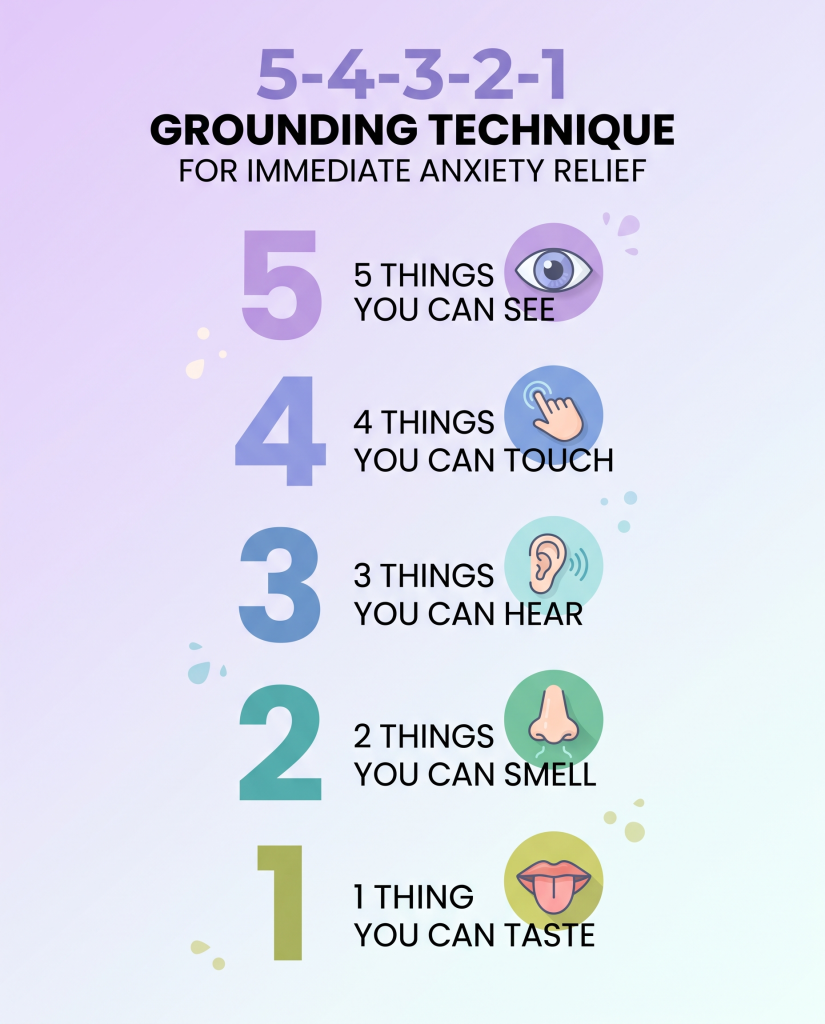
Step 2 — Use the 5-4-3-2-1 Grounding Technique
What it is: A sensory anchoring exercise that systematically pulls your attention away from anxious thoughts and back into the present physical environment.
Why it works: Anxiety lives in the future — in catastrophic “what if” scenarios that have not happened and may never happen. Grounding exercises work by forcing your brain’s prefrontal cortex (your rational, reasoning brain) to engage. When the prefrontal cortex is active, it effectively dials down the amygdala’s alarm signal. You cannot be fully present in your senses and simultaneously be lost in anxious thinking.
How to do it:
- 5 things you can SEE — look around and name them out loud or in your head. Be specific. Not just “a chair” — “a wooden chair with a torn cushion.”
- 4 things you can TOUCH — reach out and feel each one. Notice texture, temperature, weight.
- 3 things you can HEAR — listen carefully. Include background sounds you usually ignore.
- 2 things you can SMELL — even if the room seems odorless, focus and you will notice something.
- 1 thing you can TASTE — what is in your mouth right now?
Variation — The 3-3-3 Rule: If the full 5-4-3-2-1 feels overwhelming during a panic episode, use the simpler version: name 3 things you see, identify 3 sounds you can hear, and deliberately move 3 parts of your body. This takes under 60 seconds and still effectively interrupts the anxiety spiral.
Best used when: You feel detached from reality, overwhelmed, or like your thoughts are spiraling out of control.
Step 3 — Apply Temperature Shock (Cold Water Method)
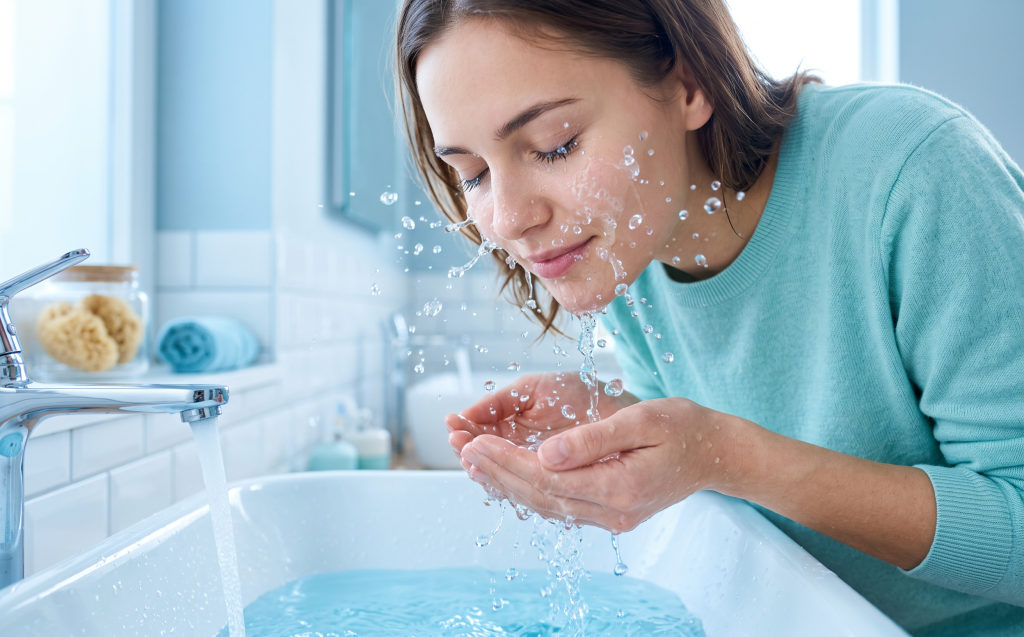
What it is: Using cold temperature to activate the mammalian dive reflex and rapidly slow your heart rate.
Why it works: Mammals have an evolutionary reflex that triggers when the face is submerged in cold water: the heart rate slows, blood is redirected to vital organs, and the nervous system shifts into a calmer state. This is called the mammalian dive reflex, and you can activate it intentionally to interrupt a panic attack within seconds. Cold water also activates the vagus nerve directly through the face, which is rich in vagal nerve endings.
How to do it:
- Option 1 (Easiest): Splash ice-cold water on your face and the back of your wrists. Repeat 2 to 3 times.
- Option 2: Hold an ice cube in your palm or press it against the inside of your wrist. Focus entirely on the cold sensation.
- Option 3 (Most Powerful): Fill a bowl with cold water and ice. Submerge your face for 15 to 30 seconds while holding your breath. This directly triggers the dive reflex and is one of the fastest anxiety interventions known.
Speed of relief: 30 to 90 seconds — this is the fastest single technique in this guide.
Best for: People mid-panic attack, experiencing a very high heart rate, or who find it difficult to focus on breathing during intense anxiety.
Step 4 — Move Your Body to Burn Off Adrenaline
What it is: Using deliberate physical movement to metabolize the stress hormones that anxiety has flooded into your system.
Why it works: Adrenaline is a performance-enhancing hormone designed to fuel physical action. When you are anxious but physically still — sitting at your desk, lying in bed, or standing frozen in fear — that adrenaline has nowhere to go. It keeps circulating, keeping your body in high alert. Physical movement burns off the adrenaline, completes the biological stress cycle, and gives your nervous system permission to downshift.
Research on the stress inoculation model suggests that even brief bursts of movement can produce measurable reductions in anxiety within minutes. Animals in the wild instinctively shake and tremble after a threatening encounter — this is their natural way of discharging stress hormones from the body. Humans have the same capacity.
How to do it:
- 10 to 20 jumping jacks — fast and energetic
- A brisk 2 to 5 minute walk, ideally outside
- Shake out your hands, arms, and legs vigorously for 30 seconds
- Jog in place for 60 seconds
- Dance aggressively to one loud song
Speed of relief: 3 to 7 minutes
Pro tip: If you cannot move much due to your location, even tensing your leg muscles under a desk and repeatedly squeezing and releasing your fists can provide some of this adrenaline-burning benefit.
Step 5 — Practice Progressive Muscle Relaxation (PMR)
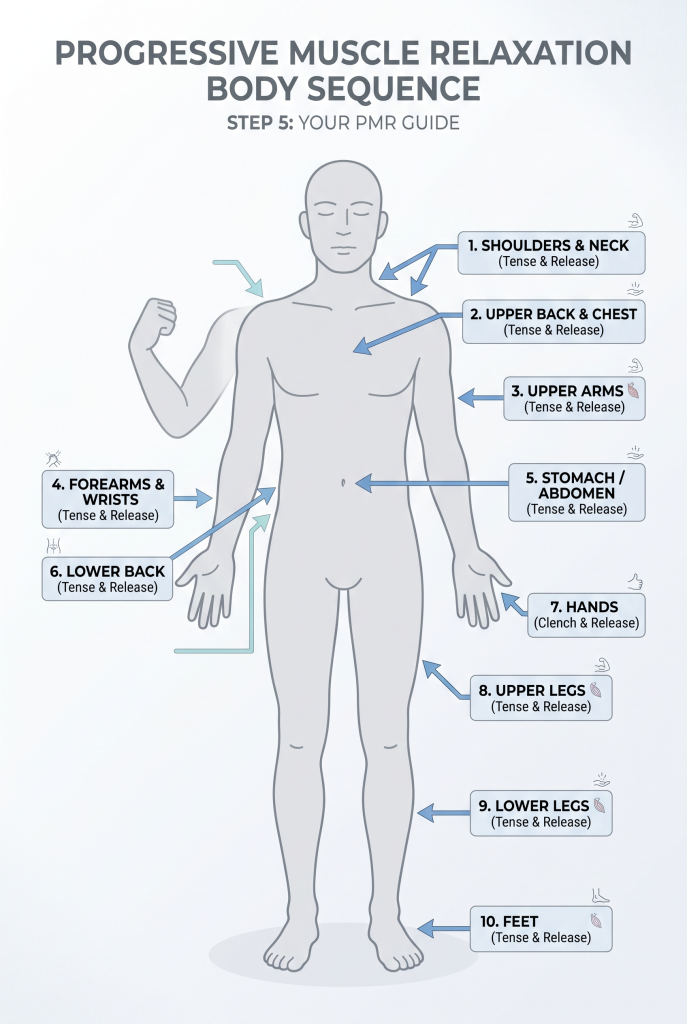
What it is: A structured mind-body technique involving the deliberate tensing and releasing of muscle groups throughout the body.
Why it works: Anxiety causes the body to hold chronic muscular tension — often without conscious awareness. People carry tight shoulders, clenched jaws, contracted abdomens, and braced legs for hours without realizing it. Progressive muscle relaxation creates a powerful physiological contrast: when a muscle is deliberately tensed and then fully released, the resulting relaxation is deeper than the resting baseline. Over a full body sequence, this creates a profound physical calm that directly signals the nervous system to downregulate.
How to do it:
- Find a comfortable seated or lying position
- Begin at your shoulders — shrug them up toward your ears, hold for 5 seconds, then drop them completely. Breathe out fully as you release.
- Move to your chest — take a deep breath and hold it to create chest tension, then exhale fully and let all tension go
- Abdomen — draw your stomach in tightly for 5 seconds, then release
- Hands and forearms — make fists as tight as possible, hold for 5 seconds, release
- Legs — press your feet into the floor and tense your thighs and calves, hold for 5 seconds, release
- Feet — curl your toes downward, hold, release
Speed of relief: 5 to 10 minutes for the full sequence. A partial version targeting just shoulders, hands, and legs works in 2 to 3 minutes.
Best for: Anxiety that is held physically in the body, tension headaches, jaw clenching, and people who find breathing exercises difficult.
Step 6 — Use Guided Imagery and Mental Visualization
What it is: Deliberately creating a detailed, multi-sensory mental image of a peaceful or comforting place to shift the nervous system out of threat mode.
Why it works: Neuroscience research has demonstrated that the brain responds in measurably similar ways to vividly imagined experiences as it does to real ones. When you imagine yourself in a safe, peaceful environment with enough sensory detail, your body begins to physiologically respond as if you are actually there — heart rate slows, breathing deepens, and the stress hormone response diminishes. This is why elite athletes use visualization to reduce performance anxiety, and why therapists use guided imagery with trauma patients.
How to do it:
- Close your eyes and choose a real or imagined peaceful place — a beach, a forest, a cozy room, a garden, a memory of somewhere you have felt completely safe
- Build the image slowly and with maximum sensory detail:
- Sight: What do you see? Colors, light, shapes, movement
- Sound: What do you hear? Water, wind, music, silence
- Touch: What do you feel? Sun on your skin, sand underfoot, cool air
- Smell: Salt water, pine trees, fresh rain, coffee, flowers
- Taste: Whatever feels right in this place
- Take 5 slow, deep breaths while holding the image
- With each inhale, imagine breathing in calm, safety, and peace
- With each exhale, imagine releasing fear, tension, and worry
Best for: Situations where you cannot physically leave — an MRI scanner, a crowded airplane, a tense waiting room, a difficult meeting. This technique requires nothing but your own imagination.
Step 7 — Label and Acknowledge Your Anxiety (Name It to Tame It)
What it is: The deliberate verbal or written identification and acknowledgment of your emotional state, rather than fighting or suppressing it.
Why it works: One of the most counterintuitive but consistently supported findings in anxiety research is that fighting anxiety makes it worse. Trying to suppress, deny, or push away anxious feelings increases their intensity — a phenomenon called “thought rebound” or the white bear effect (try not to think about a white bear, and you immediately think of one).
Conversely, naming your emotion out loud engages the prefrontal cortex and reduces activity in the amygdala. Studies in affective neuroscience, including foundational work by Matthew Lieberman at UCLA, show that labeling emotions with words measurably reduces their physiological and psychological intensity. PTSD research specifically demonstrates that people who can verbally label their threat response recover more quickly than those who cannot.
How to do it:
- Say out loud or write down: “I am feeling anxious right now. This feeling is temporary and will pass.”
- Ask yourself: “Is this threat real or perceived? What is actually happening in this moment?”
- Challenge the catastrophic thought: “What is the realistic probability that the worst outcome will occur?”
- Try saying: “I notice I am feeling anxiety. I can allow this feeling to be here without it controlling me.”
This is not toxic positivity. It is cognitive defusion — creating enough distance between you and the feeling to reduce its grip.
Step 8 — Engage the Senses Through Smell and Touch
What it is: Using tactile and olfactory input to ground the nervous system and activate calming physiological responses.
Why it works: The olfactory system — your sense of smell — has a uniquely direct pathway to the limbic system, which is the emotional processing center of the brain. Unlike all other senses, smell bypasses the thalamic relay station and connects directly to the amygdala and hippocampus. This is why a particular smell can trigger a memory or an emotion almost instantly. Certain scents — lavender most prominently, but also bergamot, chamomile, and frankincense — have demonstrated anxiolytic (anxiety-reducing) effects in clinical studies.
Touch activates mechanoreceptors in the skin that connect to calming pressure pathways in the nervous system. This is the same principle behind weighted blankets, self-massage, and the comfort of physical contact.
How to do it:
- Spray or inhale lavender essential oil — breathe it in deeply for 5 to 10 breaths
- Squeeze a stress ball or textured object with rhythmic, intentional pressure
- Rub your feet slowly over a golf ball or tennis ball (the sole of the foot has dense nerve endings)
- Give yourself a slow, deliberate hand massage — press your thumbs into the center of your palm and use firm, circular movements
Step 9 — Use Sound and Music as Anxiety Interruption
What it is: Using auditory input — particularly music — to redirect the anxious brain into different neural territory.
Why it works: Listening to and especially playing music activates multiple brain regions simultaneously, including areas involved in emotion, memory, motor control, and reward. This multisensory neural engagement competes directly with the anxiety response. Research published in PLOS ONE found that one song — Marconi Union’s “Weightless” — produced an average 65% reduction in anxiety in participants, more than any other intervention tested. The brain genuinely cannot maintain full anxious focus while processing rich musical input.
How to do it:
- Create a dedicated calm playlist in advance — do not wait until you are anxious to find music. Have it ready.
- Put on headphones and listen with full attention — this is not background music
- Hum or sing along if possible — vibrating your vocal cords stimulates the vagus nerve
- If you speak a second language, switch to it — reading, listening, or speaking in a non-native language activates a different brain region and shifts cognitive focus away from emotional processing
- If you play an instrument, even 5 minutes of practice works powerfully — you cannot play music and catastrophize simultaneously
Step 10 — Reach Out and Talk to Someone
What it is: Using human social connection as a direct nervous system regulation tool.
Why it works: Polyvagal Theory, developed by neuroscientist Dr. Stephen Porges, explains that the human nervous system has evolved to use co-regulation — the process of one person’s calm nervous system helping to regulate another person’s activated one. When you are with a calm, trusted person, your nervous system literally picks up cues of safety from theirs — through their voice tone, facial expressions, and body language. This activates the ventral vagal complex, the newest and most sophisticated branch of the parasympathetic nervous system, and produces a feeling of genuine safety that is very difficult to generate alone.
How to do it:
- Call or text a trusted friend or family member — even just saying “I’m feeling anxious right now and I needed to hear a voice” is enough
- Describe what you are experiencing out loud to them — the act of narrating your feelings engages the prefrontal cortex (the labeling effect from Step 7)
- If you are alone with no one available, contact a support line — speaking to a calm stranger has co-regulatory benefits too
Crisis resources:
| Resource | Country | Contact |
|---|---|---|
| Samaritans | UK | 116 123 |
| Crisis Text Line | US | Text HOME to 741741 |
| Beyond Blue | Australia | 1300 22 4636 |
| Mind | UK | www.mind.org.uk |
| NAMI Helpline | US | 1-800-950-6264 |
15 More Ways to Reduce Anxiety Fast When You’re in a Pinch
When your go-to techniques are not available or you want something quick and simple, these additional anxiety relief techniques can bridge the gap:
- Chew gum — Studies show chewing gum reduces cortisol levels and lowers anxiety, possibly by engaging the jaw and mimicking feeding behavior, which signals safety
- Count backward from 100 by 7s — 100, 93, 86, 79… This forces your analytical brain to engage fully, leaving little room for anxious thought
- Cuddle with a pet — Physical contact with animals releases oxytocin and has measurable stress-reducing effects. Even stroking a pet’s fur for 5 minutes lowers cortisol
- Eat a small piece of dark chocolate — Dark chocolate (70% or above) contains flavonoids that reduce cortisol and contains magnesium, which has a calming effect on the nervous system
- Step outside for fresh air and sunlight — Natural light regulates cortisol rhythms. Even 5 minutes outside changes your sensory environment and breaks the indoor anxiety loop
- Declutter or reorganize one small area — Creating order in your external environment creates a sense of control that counteracts the helplessness anxiety produces
- Write down what you are worried about — Externalizing anxious thoughts onto paper removes them from the looping mental cycle. Once written, they feel more finite and manageable
- Make a to-do list — Structure and order signal to the brain that situations are manageable, which directly counteracts the catastrophic thinking that fuels anxiety
- Watch a funny video — Genuine laughter releases endorphins, temporarily suppresses the cortisol response, and — like music — engages enough neural real estate to crowd out anxious thought
- Use the “file it” technique — Imagine a filing cabinet. Write each anxious thought on a mental file folder, acknowledge it as real and valid, and consciously place it in the cabinet. You are not dismissing the thought; you are scheduling it for later
- Spend 5 minutes completely alone in silence — For some people, social overstimulation drives anxiety. A few minutes of deliberate, quiet solitude can act as a full reset
- Stretch your jaw, neck, and shoulders — These three areas store the majority of chronic anxiety-related tension. A 60-second stretch routine targeting them produces immediate physical relief
- Sip cold water slowly — Deliberate, mindful sipping engages sensory focus, regulates core body temperature, and provides mild vagal stimulation. Keep a glass of cold water nearby at all times
- Squeeze and release your fists repeatedly — A simplified, invisible version of progressive muscle relaxation that works even in a meeting or on public transport
- Meditate for just 3 minutes using a free app — Apps like Calm, Headspace, Insight Timer, or Woebot offer guided sessions as short as 3 minutes. Even this brief duration produces measurable nervous system calming
Comparing the Best Techniques to Reduce Anxiety Immediately
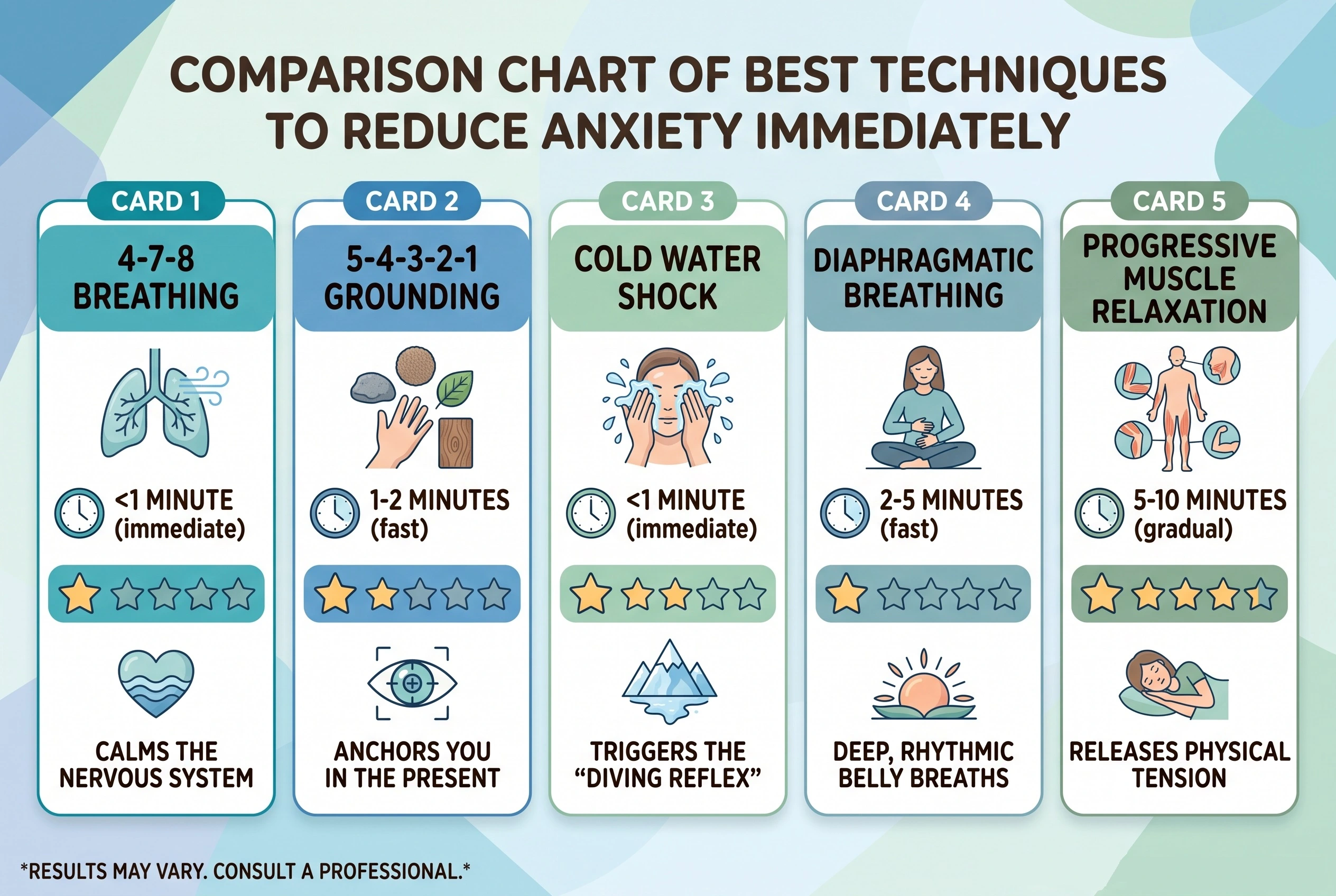
Which Anxiety Relief Method Works Best for Your Situation?
| Technique | Time to Work | Best For | Difficulty Level | Works Alone? | Science-Backed? |
|---|---|---|---|---|---|
| Deep Breathing (4-7-8) | 2–5 min | Panic, racing heart | Easy | ✅ Yes | ✅ Yes |
| 5-4-3-2-1 Grounding | 3–5 min | Dissociation, overwhelm | Easy | ✅ Yes | ✅ Yes |
| Cold Water Shock | 30–90 sec | Acute panic, high heart rate | Easy | ✅ Yes | ✅ Yes |
| Physical Movement | 3–7 min | Adrenaline surge, restlessness | Moderate | ✅ Yes | ✅ Yes |
| Progressive Muscle Relaxation | 5–10 min | Body tension, stress headache | Moderate | ✅ Yes | ✅ Yes |
| Guided Imagery | 5–10 min | Trapped situations, medical anxiety | Moderate | ✅ Yes | ✅ Yes |
| Talking to Someone | 10–20 min | Loneliness, isolation anxiety | Easy | ❌ Needs another person | ✅ Yes |
| Music/Sound Therapy | 5–15 min | General anxiety, stress | Easy | ✅ Yes | ✅ Yes |
| Journaling | 10–15 min | Racing thoughts, overthinking | Easy | ✅ Yes | ✅ Yes |
| Aromatherapy (Lavender) | 5–10 min | Mild-moderate anxiety | Easy | ✅ Yes | ⚠️ Partial evidence |
Breathing Techniques Compared — Which One Is Right for You?
| Breathing Method | Pattern | Best For | Speed of Relief |
|---|---|---|---|
| 4-7-8 Breathing | Inhale 4 / Hold 7 / Exhale 8 | Deep calm, sleep anxiety | Medium (3–5 min) |
| Box Breathing | 4 / 4 / 4 / 4 | Stress, performance anxiety | Medium (3–5 min) |
| Diaphragmatic Breathing | Belly-focused, slow exhale | Panic attack, general anxiety | Fast (2–3 min) |
| Resonance Breathing | 5 to 6 breaths per minute | Heart rate regulation | Slower (5–10 min) |
| Simple Exhale Extension | Inhale 4 / Exhale 6-8 | Beginners, immediate relief | Very fast (1–2 min) |
Understanding What Type of Anxiety You’re Experiencing
It is important to recognize that not all anxiety is the same. The immediate techniques in this guide can help anyone experiencing an acute anxiety episode. But understanding the broader pattern of your anxiety — whether it is situation-specific, recurring, or connected to a deeper condition — is critical for deciding your next steps.
Common Anxiety-Related Conditions to Know About
| Symptom Pattern | Possible Condition | Recommended Next Step |
|---|---|---|
| Persistent, pervasive worry affecting daily life | Generalized Anxiety Disorder (GAD) | Speak with a GP or licensed therapist |
| Overwhelming fear of a specific object, place, or situation | Specific Phobia | Exposure therapy with a professional |
| Recurring, unexpected panic attacks | Panic Disorder | CBT evaluation or medication assessment |
| Reliving traumatic events through flashbacks or nightmares | PTSD | Trauma-focused therapy (EMDR or CPT) |
| Intense fear and avoidance of social situations | Social Anxiety Disorder | CBT, social skills training |
Important: This table is for informational awareness only. Do not self-diagnose. If you recognize yourself in any of these patterns, speak with a qualified mental health professional for a proper assessment. These conditions are highly treatable, especially with early intervention.
What Helps Reduce Anxiety Beyond the Immediate Moment
The techniques in this guide are powerful for managing acute anxiety. But if anxiety is a recurring experience in your life, long-term resilience requires building sustainable daily habits that lower your baseline anxiety level and make your nervous system more robust over time.
Daily Habits That Build Anxiety Resilience Over Time
Regular aerobic exercise is among the most powerful long-term anxiety interventions known. Aim for at least 150 minutes of moderate-intensity activity per week — brisk walking, cycling, swimming, or jogging all work. Exercise reduces baseline cortisol, increases BDNF (a protein that supports brain health and emotional regulation), and produces endorphins that genuinely shift your mood baseline.
Consistent sleep is non-negotiable for anxiety management. Sleep deprivation directly increases amygdala reactivity — meaning a tired brain is a more anxious brain. Aim for 7 to 9 hours per night, with consistent wake and sleep times. [Read more about how to sleep better with anxiety.]
Limiting caffeine and alcohol makes a significant difference for people prone to anxiety. Caffeine is a stimulant that increases heart rate, can trigger panic-like sensations, and reduces sleep quality. Alcohol is a short-term sedative that disrupts sleep architecture and increases anxiety the following day.
Eating regular, balanced meals keeps blood sugar stable. Dips in blood sugar trigger cortisol release and create physical symptoms that closely mimic anxiety — shakiness, brain fog, irritability, and heart palpitations.
Building a genuine social support network provides ongoing co-regulatory benefit. Loneliness and social isolation are among the strongest predictors of anxiety disorders. Investing in close, authentic relationships is protective.
Daily mindfulness practice — even 5 to 10 minutes of formal meditation, mindful breathing, or body scanning — has robust evidence for reducing trait anxiety over time. Consistency matters more than duration.
What to Avoid When You’re Anxious
Just as important as what to do is what not to do. These common coping responses feel helpful in the short term but consistently worsen anxiety over time:
- ❌ Alcohol and recreational drugs — provide temporary relief by numbing the nervous system but disrupt neurochemistry, worsen sleep, and create dependence cycles that amplify anxiety
- ❌ Complete avoidance of anxiety-provoking situations — avoidance provides short-term relief but signals to the brain that the avoided thing is genuinely dangerous, which reinforces and expands the anxiety over time
- ❌ Excessive news and social media consumption — designed to be emotionally activating, these environments keep the threat-detection system chronically engaged
- ❌ Caffeine overconsumption — amplifies physical anxiety symptoms and lowers the threshold for panic
- ❌ Isolation — cuts you off from the co-regulatory benefit of social connection and allows anxious thinking to go unchallenged
- ❌ Suppressing or fighting the anxiety — paradoxically increases its intensity; acceptance and acknowledgment are more effective than resistance
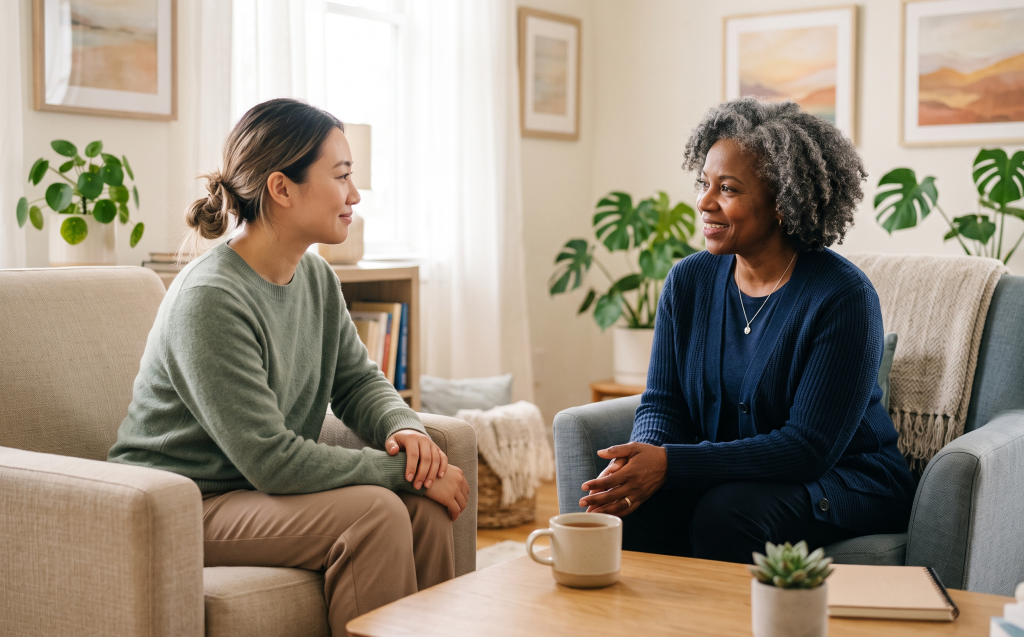
When Self-Help Isn’t Enough — Knowing When to Seek Support
There is nothing weak about needing support for anxiety. The nervous system is a biological system, and like any biological system, it can become dysregulated in ways that go beyond what self-help can address. Recognizing when you have reached that threshold is not failure — it is self-awareness and courage.
Signs You Should Talk to a Doctor or Therapist
Consider professional support if:
- Anxiety attacks are occurring more than once a week
- Anxiety is interfering with your ability to work, maintain relationships, or fulfill daily responsibilities
- You are progressively avoiding more situations, places, or people because of anxiety
- The self-help techniques in this guide are not providing adequate relief
- You are experiencing persistent low mood, hopelessness, or depression alongside your anxiety
- You are using alcohol, substances, or other numbing behaviors to cope with anxiety
- You are having thoughts of harming yourself
None of these experiences mean you are broken. They mean your nervous system needs more support than coping strategies alone can provide — and that support is available.
Types of Professional Help Available
GP or Primary Care Doctor: Your first point of contact. A GP can rule out physical causes, provide medication if appropriate, and refer you to mental health services.
Cognitive Behavioral Therapy (CBT): The gold standard psychological treatment for anxiety disorders. CBT teaches you to identify and restructure the thought patterns that drive anxiety, and to gradually face feared situations in a controlled way. It has the strongest evidence base of any therapeutic approach for anxiety.
NHS Talking Therapies (UK): If you are in the UK, you can self-refer to an NHS Talking Therapies service without needing a GP referral. This applies to those aged 16 and above in most areas.
Private Therapists and Counselors: If waiting times for NHS services are long, private therapy offers faster access. Look for therapists with accreditation from BACP (UK), APA (US), or equivalent professional bodies.
Mental Health Crisis Lines: For emergencies or when immediate human support is needed.
| Resource | Country | Contact |
|---|---|---|
| Samaritans | UK | 116 123 |
| Crisis Text Line | US | Text HOME to 741741 |
| Beyond Blue | Australia | 1300 22 4636 |
| Mind | UK | www.mind.org.uk |
| NAMI Helpline | US | 1-800-950-6264 |
Common Questions About How to Reduce Anxiety Immediately
How long does it take to reduce anxiety immediately with breathing?
Most controlled breathing techniques begin producing measurable calming effects within 2 to 5 minutes of consistent practice. The Simple Exhale Extension method — where you simply make your exhale longer than your inhale — is the fastest, often producing noticeable relief within 60 to 90 seconds. The key factor is the length of the exhale, not the inhale. The longer and slower your exhale, the stronger the vagal activation and the faster the calming response.
Can drinking water help reduce anxiety immediately?
Yes, and more than most people realize. Sipping cold water slowly engages deliberate sensory focus, which activates grounding pathways in the brain. Cold water regulates core body temperature, which often rises during anxious arousal. Staying well-hydrated also directly supports cortisol regulation — even mild dehydration has been shown to increase perceived stress and anxiety. Keeping a glass of cold water nearby is one of the simplest, most accessible anxiety first-aid measures available.
Does exercise really help reduce anxiety right away?
Absolutely, and the research is consistent. Even 5 to 10 minutes of brisk aerobic movement produces measurable reductions in anxiety through multiple mechanisms: it burns off circulating adrenaline, increases endorphin production, reduces muscle tension, and shifts cognitive focus away from anxious thought. The effect is not subtle — many people describe feeling a recognizable physical and mental shift within minutes of starting movement. You do not need a gym or a structured workout. A fast walk around the block, a few minutes of dancing in your kitchen, or a short jog to the end of the street and back all work.
What is the fastest way to stop a panic attack?
The fastest approach combines three techniques simultaneously for a multi-channel intervention:
- Cold water shock — splash ice-cold water on your face or submerge your face in cold water to trigger the mammalian dive reflex (30 to 90 seconds)
- Extended exhale breathing — inhale for 4 seconds, exhale for 8 seconds, focused and deliberate
- 5-4-3-2-1 grounding — work through all five senses to anchor yourself in the present
Using all three together creates overlapping signals of safety reaching the nervous system through different pathways simultaneously, producing faster relief than any single technique alone.
Why does anxiety feel worse at night?
Several factors converge at night to amplify anxiety. First, daytime distractions disappear — there is no work, no activity, no social input to keep your mind occupied, so anxious thoughts fill the silence. Second, cortisol fluctuates across a 24-hour cycle and its patterns can contribute to nighttime anxiety surges. Third, lying still gives adrenaline nowhere to go — without movement, stress hormones linger longer. Fourth, sleep deprivation creates a feedback loop: anxiety disrupts sleep, and poor sleep worsens anxiety the following day. Addressing nighttime anxiety specifically may require a dedicated wind-down routine, consistent sleep timing, and possibly CBT-I (Cognitive Behavioral Therapy for Insomnia). [See our guide: How to Sleep Better with Anxiety.]
Is it safe to use home remedies to reduce anxiety immediately?
Yes, for mild to moderate anxiety. The techniques described in this guide — breathing, grounding, cold water, movement, muscle relaxation, journaling, and sensory engagement — are all safe, non-invasive, and non-addictive. They have been used in clinical and therapeutic contexts for decades and carry no meaningful side effects with regular use. That said, they address symptoms rather than root causes. For severe, frequent, or clinically significant anxiety, home remedies should be used alongside — not instead of — professional evaluation and care.
Frequently Asked Questions — How to Reduce Anxiety Immediately
Q1: What is the single fastest way to reduce anxiety immediately?
The fastest single technique is cold water shock — specifically, submerging your face in cold water or splashing ice water on your face and wrists. This triggers the mammalian dive reflex and can reduce heart rate measurably within 30 to 90 seconds. Combining it with slow exhale-focused breathing and 5-4-3-2-1 grounding creates the most powerful immediate intervention known. Most people using this combination report significant relief within 2 minutes.
Q2: Can I use these techniques for someone else having an anxiety attack?
Yes, and your presence alone is already helping through nervous system co-regulation. Guide them calmly through breathing — breathe with them to model the pace. Speak in a slow, low, steady voice. Do not minimize their experience or tell them to “calm down” — instead say: “I’m here. You’re safe. Let’s breathe together.” Encourage grounding by asking them to name things they can see. Ask before offering physical touch. Your calm is genuinely contagious to their nervous system in the most literal, biological sense.
Q3: How do I reduce anxiety immediately at work without anyone noticing?
Several techniques are completely invisible in a professional setting. Box breathing requires no visible movement and no closed eyes — you can do it in a meeting. The 5-4-3-2-1 grounding technique can be done silently while maintaining eye contact. Under-desk fist squeezing provides progressive muscle relaxation without drawing attention. Slow jaw relaxation — gently touching the tip of your tongue to the roof of your mouth — releases facial tension invisibly. If you can step away for even 2 minutes — a bathroom visit or a “getting water” break — use that time for cold water on the wrists and a few minutes of breathing.
Q4: Are there any foods that help reduce anxiety quickly?
Some foods have genuine anxiolytic properties, though their effects are slower than the techniques in this guide (typically 20 to 40 minutes). Dark chocolate (70% or higher) reduces cortisol and contains magnesium and theobromine, which have mild calming effects. Chamomile tea contains apigenin, a compound that binds to GABA receptors in the brain similarly to benzodiazepine medications. Magnesium-rich foods (spinach, almonds, pumpkin seeds) support nervous system regulation. Foods rich in tryptophan (turkey, bananas, eggs) provide the precursor to serotonin. These are best understood as supportive nutritional strategies rather than immediate interventions.
Q5: What should I do if breathing exercises make my anxiety worse?
This is more common than most people realize. Some individuals have a paradoxical reaction to focused breathing — the act of paying attention to breath triggers awareness of physical sensations, which can spiral into hyperventilation anxiety or health-focused catastrophizing. If this happens to you, do not force it. Instead, start with grounding (5-4-3-2-1), cold water, or physical movement. Over time, working with a therapist on interoceptive exposure — gradually building tolerance to internal body sensations — can resolve this reaction.
Q6: Can children and teenagers use these techniques?
Yes. Breathing exercises, grounding techniques, guided imagery, and progressive muscle relaxation are all widely used in pediatric and adolescent mental health settings. Adapt the language to the child’s age and development — younger children may respond well to “balloon breathing” (imagining their belly is a balloon they fill slowly) or simplified grounding like “Find 3 blue things in this room.” In the UK, teenagers aged 16 and over can self-refer to NHS Talking Therapies services in most areas without needing parental consent or a GP referral.
Q7: How often can I use these anxiety-relief techniques?
As often as you need to. Every technique in this guide is safe, non-addictive, and has no harmful effects with repeated use. In fact, using them regularly — not just during crises — builds what therapists call distress tolerance and response automaticity: your nervous system becomes more practiced at calming itself, and eventually the techniques work faster and more powerfully because they are well-rehearsed pathways. Consider incorporating 2 to 3 of these techniques into your daily routine regardless of whether you are feeling anxious.
Q8: Do anxiety relief apps actually work?
Yes, with some nuance. Apps such as Calm, Headspace, Insight Timer, and Woebot (an AI-based CBT app) have accumulating research supporting their effectiveness for mild to moderate anxiety. They are particularly useful for guided breathing, sleep meditation, and brief mindfulness sessions. They work best as supplements to professional care and self-practice, not as replacements. If you are using an app and find it genuinely helpful, that is valuable. If your anxiety is severe or significantly impacts your functioning, an app is not sufficient on its own.
Q9: Why does my anxiety keep coming back even after I use these techniques?
Because immediate relief techniques address the symptom — the acute activation of your threat-response system — rather than the underlying cause. Think of it as treating a fever versus treating the infection causing the fever. The fever medicine works, but unless you treat the infection, the fever returns. Long-term reduction of anxiety requires identifying and addressing the root patterns: the cognitive distortions that fuel catastrophic thinking, the unresolved experiences that sensitized your nervous system, the lifestyle factors that keep your baseline cortisol elevated. This is where professional therapy — particularly CBT — becomes essential. Recurring anxiety after using coping techniques is a clear signal that it is worth speaking to a therapist.
Q10: Is it normal to feel tired after an anxiety or panic attack?
Completely and absolutely normal. During a fight-or-flight response, your body burns enormous amounts of energy — heart rate accelerates, muscles tense, breathing becomes rapid, and your entire system shifts into emergency mode. After the episode resolves, your body needs time to restore homeostasis. Post-attack exhaustion, shakiness, emotional fragility, and brain fog are all normal recovery symptoms and typically resolve within a few hours with rest, hydration, gentle movement, and food.
Final Thoughts on How to Reduce Anxiety Immediately
Anxiety is not your enemy. It is your nervous system doing exactly what it was designed to do — protect you. The problem is not that you feel anxious. The problem is when that protective system becomes hyperactivated, triggering emergency responses to non-emergency situations and making it difficult to live your life fully.
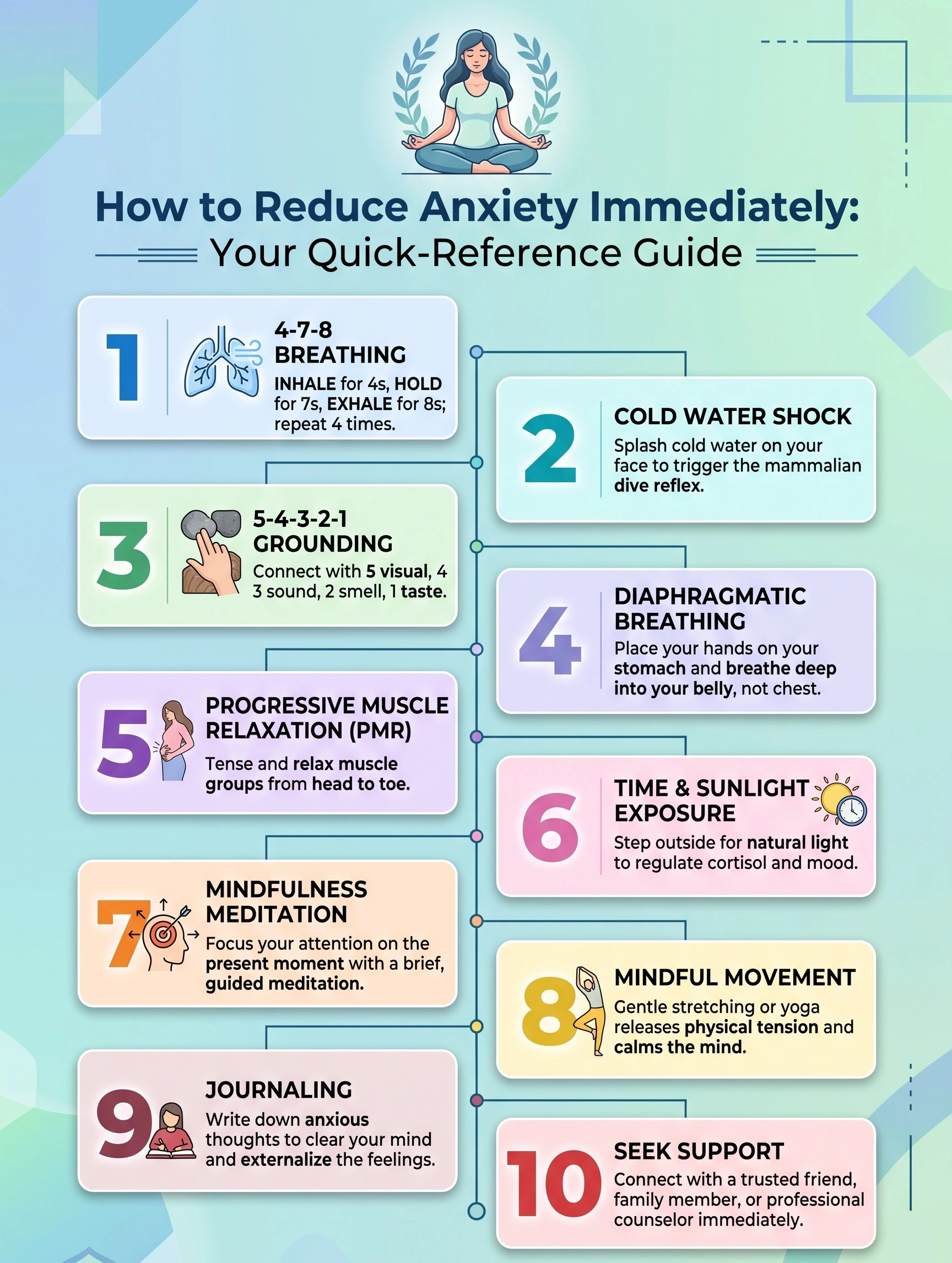
The good news — and it is genuinely good — is that you have more control over your anxiety than it may feel like in the moment. Your nervous system has an off switch. It is wired in, biological, and accessible right now.
To recap the most powerful immediate techniques:
- Extended exhale breathing — your fastest, always-available tool
- 5-4-3-2-1 grounding — anchors you in the present and overrides catastrophic thinking
- Cold water shock — the fastest physiological interrupt available
- Physical movement — burns the adrenaline anxiety is flooding into your system
- Labeling your emotion — activates the rational brain and reduces the fear brain’s grip
Practice these techniques before you need them. The time to learn the breathing pattern is not mid-panic attack. The time to practice guided imagery is not on the MRI table. Build these into your everyday life — a minute of extended exhale breathing before bed, a quick 5-4-3-2-1 check-in during your lunch break, a 3-minute meditation app session in the morning. When anxiety hits, your nervous system will know exactly where to go.
And if your anxiety is frequent, severe, or disrupting your life — please reach out for professional support. Asking for help is not weakness. It is the most powerful thing you can do for your mental health. Effective treatments exist. Recovery is real. You do not have to manage this alone.
📌 Bookmark this guide so you have it ready the next time anxiety strikes. Share it with someone who might need it. And if you found this helpful.
References:
- NHS UK. (2023). Anxiety, fear and panic. nhs.uk
- American Psychological Association. (2023). Anxiety disorders. apa.org
- Porges, S.W. (2011). The Polyvagal Theory. W.W. Norton & Company
- Lieberman, M.D. et al. (2007). Putting feelings into words: Affect labeling disrupts amygdala activity. Psychological Science, 18(5), 421–428
- Leubner, D., & Hinterberger, T. (2017). Reviewing the effectiveness of music interventions in treating depression. Frontiers in Psychology, 8, 1109
- National Institute of Mental Health. (2023). Anxiety disorders. nimh.nih.gov