
When your child shuts down before a task, melts into tears during a routine change, or freezes when you ask a simple question, the first instinct for most parents is to think: anxiety.
It is one of the most common—and costly—misreads in parenting a child with ADHD.
On the surface, anxiety and ADHD overwhelm look nearly identical. But treating a child for anxiety when the real issue is an executive function (EF) breakdown leaves everyone frustrated, misunderstood, and stuck in the same cycle.
Understanding the difference doesn’t just change how you respond—it changes everything.
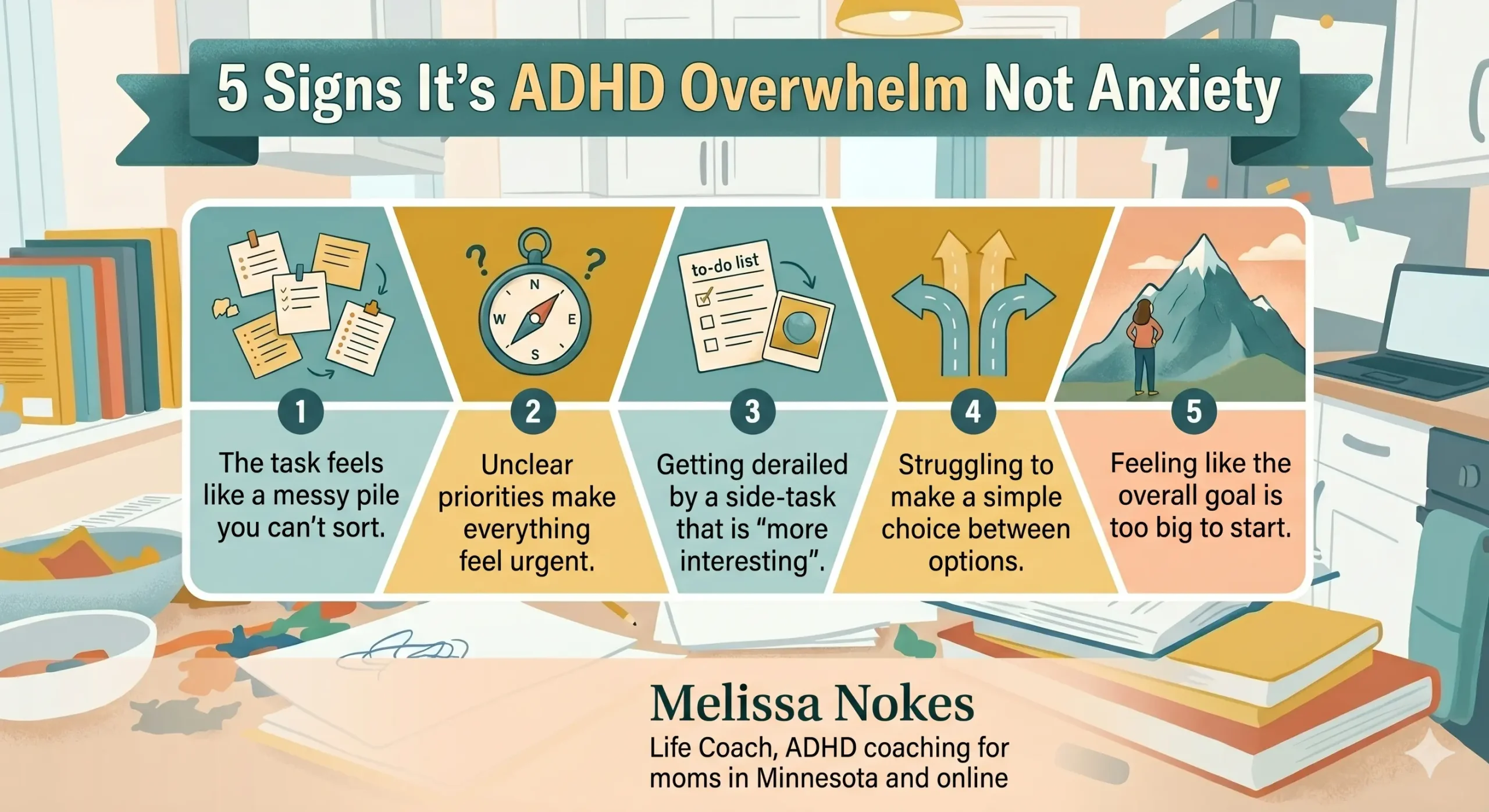
Here are five clear signs that what you’re witnessing isn’t anxiety. It’s ADHD overwhelm—and there’s a very specific reason it’s happening.
👉 Related Reading: ADHD Motherhood Challenges No One Talks About | ADHD Emotional Regulation for Moms
What Is ADHD Overwhelm—And Why Does It Look Like Anxiety?
Before we break down the signs, it helps to understand what’s actually happening in the ADHD brain.
ADHD is not simply a focus problem. At its core, ADHD is a disorder of executive function—the cognitive system that controls planning, organizing, initiating tasks, shifting attention, and managing emotions.
When a child’s executive function system is overloaded, the brain enters a state of cognitive overwhelm—not fear. The behaviors that follow can look startlingly similar to anxiety: avoidance, shutting down, crying, refusing to engage. But the root cause is completely different.
And that difference matters enormously when it comes to how you help.
Sign #1: They Want to Do It—But They Can’t Start
You ask your child to clean their room, start their homework, or put on their shoes. They sit frozen, staring into space, visibly distressed. It’s easy to assume they’re paralyzed by fear of failure or overwhelmed by worry about doing it wrong.
The Reality: This is a task initiation problem—not fear.
An anxious child avoids a task because they’re afraid of the outcome. An ADHD child genuinely wants to comply but their brain cannot identify the very first physical step needed to get moving. The starting mechanism is offline.
What this looks like in real life:
- Standing in the middle of their room not knowing where to begin
- Sitting at the desk staring at a blank page for 20 minutes
- Repeatedly saying “I’ll do it in a minute” without ever starting
What actually helps:
Give them one absurdly small micro-step. Not “clean your room”—but “pick up the three things on your floor and put them on your bed.” Task initiation in ADHD requires an external spark, not emotional reassurance.
Want support navigating this? Explore ADHD Coaching for Moms →
Sign #2: They Explode When You Try to Help
You see your child struggling, so you step in to guide them—gently offering instructions or breaking things down. Instead of feeling relieved, they completely erupt. Tears. Shouting. Shutdown. It looks like performance anxiety or emotional dysregulation.
The Reality: This is cognitive overload—not anxiety about your presence.
Here’s what’s happening: the ADHD brain is already running at full capacity, barely holding together its internal mental map of the task at hand. When you introduce new voices, new steps, or new information, you inadvertently crash the entire system.
Think of it like a computer with 47 tabs open. Adding one more causes everything to freeze.
What this looks like in real life:
- Screaming “STOP HELPING ME!” when you try to assist
- Breaking down in tears the moment you give a correction
- Becoming more disorganized, not less, when given additional direction
What actually helps:
Step back. Give them physical and mental quiet space to reset. Once they’re regulated, then offer one single instruction at a time—and wait for it to be processed before adding anything else.
Sign #3: They Cope One Day, Then Crash the Next
This is perhaps the most confusing pattern for parents. On Tuesday, your child breezes through homework, handles transitions smoothly, and listens on the first ask. On Wednesday, the exact same routine causes a complete meltdown. It looks like defiance, mood swings, or emotional instability.
The Reality: This is a fluctuation of cognitive capacity—not inconsistency or willful behavior.
Executive function requires an enormous amount of mental energy. If your child spent every ounce of their cognitive reserve holding it together on Tuesday—at school, in social situations, managing transitions—they wake up Wednesday morning running on empty. The capacity simply isn’t there.
This is sometimes called “masking fatigue” in the ADHD community. Children who mask their struggles all day at school often fall apart the moment they get home—to the person they feel safest with.
What this looks like in real life:
- “Perfect” behavior at school followed by emotional explosions at home
- Good days followed by seemingly unexplainable bad days
- Inconsistent performance that doesn’t match effort or intelligence
What actually helps:
Track patterns across the week rather than reacting day by day. Build intentional decompression time after high-demand situations. Reduce cognitive load on days following high-output days.
THE COGNITIVE SHIFT: Know What You’re Really Seeing
| Anxiety Looks Like… | ADHD Overwhelm Is… |
|---|---|
| Paralyzing worry or fear about outcomes | A breakdown in the brain’s ability to shift gears |
| Avoidance driven by a scary “what if” | A brain that physically cannot organize a task or answer |
| Needing emotional soothing and reassurance | Needing structural support and simplified steps |
| Consistent triggers (specific situations) | Fluctuating capacity based on cognitive fuel levels |
| Calmed by comfort and validation | Not resolved by reassurance alone—needs a different approach |
Sign #4: Transitions Trigger Absolute Chaos
Leaving the house for school. Stopping a video game for dinner. Shifting from recess back to class. These seemingly simple changes frequently trigger enormous behavioral storms in children with ADHD. It can look like they’re terrified of what comes next—or deeply resistant to change out of anxiety.
The Reality: This is a difficulty shifting cognitive gears—not worry about the next activity.
The ADHD brain experiences what researchers call “cognitive inertia.” Moving focus from Task A to Task B requires a significant executive function effort—the mental equivalent of stopping a freight train and redirecting it onto a different track. The chaos you see isn’t anxiety about the new environment; it’s a structural traffic jam in the brain’s switching system.
What this looks like in real life:
- Explosive reactions to “it’s time to go”
- Inability to stop mid-task even when they want to
- Requiring 10–15 minutes of chaos before settling into a new activity
What actually helps:
Build a visual, predictable countdown system. Transition warnings (“5 more minutes, then we leave”) paired with visual timers dramatically reduce the cognitive shock of switching. Predictability is the ADHD brain’s best friend.
See Also: ADHD Mom Daily Routine Tips | Managing ADHD While Raising Kids
Sign #5: They Say “I Don’t Know” Constantly
You ask a simple, direct question: “Why didn’t you finish your homework?” or “What do you want for lunch?” They shrug. They look away. They mutter “I don’t know” for the fifth time in a row. It reads as avoidance, defiance, or a deliberate refusal to engage.
The Reality: This is a working memory failure under stress—not avoidance.
Under significant cognitive load, a child’s working memory short-circuits. The information is inside their brain—but their internal retrieval system cannot organize it into a coherent, expressible answer in that moment. “I don’t know” is not an attitude. It’s a distress signal that translates to: “My brain is offline right now.”
What this looks like in real life:
- Blank stares when asked open-ended questions
- Inability to recall events from earlier in the day
- Answering questions inconsistently depending on stress level
What actually helps:
Replace open-ended questions with structured choices. Instead of “Why didn’t you do it?”—try “Was it hard to start, or did something interrupt you?” Offering a cognitive scaffold gives the overwhelmed brain something to grab onto.
The Pivot Most Parents Miss (And Why It Changes Everything)
When we assume a child is anxious, our go-to strategy is emotional soothing. We rub their back, tell them everything will be fine, and talk through their worries. Empathy is always necessary—but here’s what most parents aren’t told:
You cannot soothe an executive function struggle away.
Telling a child “You’ve got this!” doesn’t give them the structural roadmap their brain is missing. Validating their feelings doesn’t rebuild cognitive capacity. The support has to match the actual problem.
Instead of Soothing the Emotion → Solve What’s Hard
| The Struggle | What Actually Helps |
|---|---|
| Can’t start a task | Break it into one single micro-step |
| Melts down during transitions | Use a visual timer and 5-minute warnings |
| Crashes after a good day | Build decompression time into the schedule |
| Explodes when helped | Step back, give quiet space, then offer one instruction |
| Says “I don’t know” | Offer structured choices instead of open questions |
Behavior is never a random problem to be managed. It is a clear signal revealing exactly where a child’s brain is running out of road.
When we stop viewing a struggling child as anxious or defiant—and start seeing them as structurally overwhelmed—we stop managing symptoms and start solving the real problem.
You Don’t Have to Figure This Out Alone
If you’re a mom navigating ADHD—whether your child’s, your own, or both—and you’re exhausted from trying to decode what’s really happening, you don’t have to keep searching for answers by yourself.
Melissa Nokes is a certified life coach specializing in ADHD coaching for moms, postpartum mental wellness, and helping women move from survival mode into clarity and confidence.
With her MA in Counseling Psychology and certification as a Perinatal Mental Health Coach (PMH-C), Melissa brings both clinical insight and real-world coaching strategies to help you finally understand what your child—and you—actually need.
Ready to Stop Guessing and Start Understanding?
Whether you’re trying to support your child, manage your own ADHD, or simply feel less overwhelmed—Melissa offers personalized coaching packages designed around where you are right now.
Book a Free Discovery Call →
Explore ADHD Coaching Services →
View All Coaching Packages →
📍 Serving Apple Valley, MN and the Twin Cities | 💻 Virtual Coaching Available Nationwide
📞 (612) 499-0692 | ✉️ melissanokeslifecoach@gmail.com
Frequently Asked Questions
Q: What is the difference between ADHD overwhelm and anxiety in children?
A: Anxiety is driven by fear of an outcome—a child avoids something because they’re afraid of what might happen. ADHD overwhelm is driven by executive function failure—the child’s brain cannot organize, initiate, or shift gears regardless of how much they want to comply. The behaviors look similar, but the root cause and the solution are completely different.
Q: Why does my ADHD child do well one day and fall apart the next?
A: This is called cognitive capacity fluctuation. Executive function requires significant mental energy. If a child used all their reserves on a high-demand day—school, social situations, transitions—they wake up the next day with an empty tank. It’s not defiance or inconsistency; it’s a brain running out of fuel.
Q: How do I help a child with ADHD who can’t start tasks?
A: Task initiation is one of the most common executive function challenges in ADHD. Instead of encouraging or reassuring, break the task into one single, absurdly small first step. External prompts, visual schedules, and timers can help bridge the gap that ADHD brains struggle to cross on their own.
Q: Why does my child explode when I try to help them with ADHD?
A: When an ADHD brain is already at full cognitive capacity, adding new instructions—even helpful ones—can crash the system entirely. Step back, give quiet space to reset, and then offer one clear, simple direction at a time once they’re regulated.
Q: Can ADHD coaching help moms who are managing a child with ADHD?
A: Absolutely. ADHD coaching for moms helps you understand your child’s neurological patterns, build systems that work with their brain instead of against it, and manage the emotional weight of parenting a child with ADHD—especially if you’re also navigating your own ADHD or postpartum mental health challenges.